


 fr
fr
 es
es
 de
de
 it
it


ABOUT US
WHAT IS IT?
Nature Preserved — The Guide to Preserved Plants
A vase filled with preserved hydrangeas, a floral arrangement, a large-scale green wall or a suspended installation… preserved plants offer countless possibilities for bringing real nature into interior spaces — beautifully and for the long term.
Natural, maintenance-free and requiring no watering, they appeal to florists and decorators just as much as to architects, interior designers and other design professionals. But as projects grow in scale, understanding the plants, their properties and the environment in which they will be used becomes increasingly important.
This is precisely the purpose of Nature Preserved — The Definitive Guide to Preserved Plants, the new guide by preserved plants consultant Edgardo Rossi, published in collaboration with the Journal of Biophilic Design.
With a foreword by Dr Vanessa Champion, this approximately 130-page guide explores preserved plants from every angle and gives professionals valuable insights into how to integrate them successfully into their projects.
The guide is written in English and is available to download or read online free of charge.
From passion to expertise
At SecondFlor, we have known Edgardo for several years. Before becoming a specialist consultant, he worked for a botanical design company, where he was already using preserved plants in a wide variety of projects.
Over the years, this hands-on experience developed into a genuine area of expertise.
Today, through Preserved Plants Design, Edgardo works with architects, designers, project teams and greenery professionals, helping them understand how best to use preserved plants in interior spaces.
With Nature Preserved, he wanted to take this work a step further: to bring his experience together in a guide accessible to professionals and contribute to a better understanding of preserved plants.
Creating a common language for professionals
Although preserved plants are now widely used, knowledge and understanding of them can still vary considerably from one profession to another.
For Edgardo, this is precisely what the industry has been missing: a resource capable of bridging the gap between those who design projects, those who specify them and those who bring them to life.
“Preserved plants are widely used, yet they are still poorly understood. There is no common language and no shared set of standards. This book gives architects, designers and specifiers the knowledge they need to better define their requirements for preserved plants, while helping installation companies respond to those requirements appropriately.”
What makes this approach particularly valuable is that the guide is completely independent: it does not recommend any brand or supplier. Its primary purpose is to share knowledge and encourage better practices.
From a simple vase to an interior design project
This is one of the great strengths of preserved plants: simplicity does not limit creativity.
A few stems of preserved gypsophila, eucalyptus or hydrangea are all it takes to bring lasting natural beauty to a vase or table. With no water, no light and no maintenance required, preserved botanicals make it remarkably easy to create natural arrangements that retain their beauty for years.
But preserved plants can also be incorporated into much more ambitious interior projects: green walls, botanical ceilings, suspended installations, scenography and bespoke creations.
In the right conditions, preserved plants can last for years. The environment should therefore always be taken into account when selecting the plants best suited to a project.
This does not make preserved plants more complicated to use. Quite the opposite: it helps professionals make the most of their potential and create installations designed to last.
For professionals looking to incorporate preserved plants into larger-scale interior projects, Edgardo’s guide provides valuable guidance on when preserved plants are the right solution and how to integrate them successfully into a project.
Living, preserved or artificial: how do you choose?
Nature Preserved does not seek to place the different ways of bringing greenery indoors in opposition to one another.
Instead, Edgardo suggests starting with the space itself and the objectives of the project to determine which solution is most appropriate.
He sums up this philosophy in a few words:
“Living where the space sustains it. Preserved where it does not.”
Where the conditions can sustainably support living plants, they naturally have their place. Where light levels, access to water, maintenance requirements or other constraints make living plants difficult to sustain, preserved plants open up new possibilities.
They make it possible to introduce real plants into spaces where living vegetation would otherwise be difficult to maintain, with no watering and no need for natural light.
16 chapters exploring every dimension of preserved plants
Across its 16 chapters, Nature Preserved goes far beyond a simple introduction.
Edgardo explains what preserved plants are and how they are produced, while also exploring how they can be used in interior spaces: plant selection, display conditions, longevity, integration into biophilic design and their relationship with living plants.
For more technical projects, the guide also covers installation design, fire safety, acoustics, technical documentation and certification, long-term costs and circularity.
And because there is no substitute for real-world experience, the book concludes with three case studies based on projects led by Edgardo: two hotel projects in the Milan area and a biophilic design project in Lugano.
Together, these topics take readers from discovering preserved plants to gaining a much deeper understanding of their possibilities.
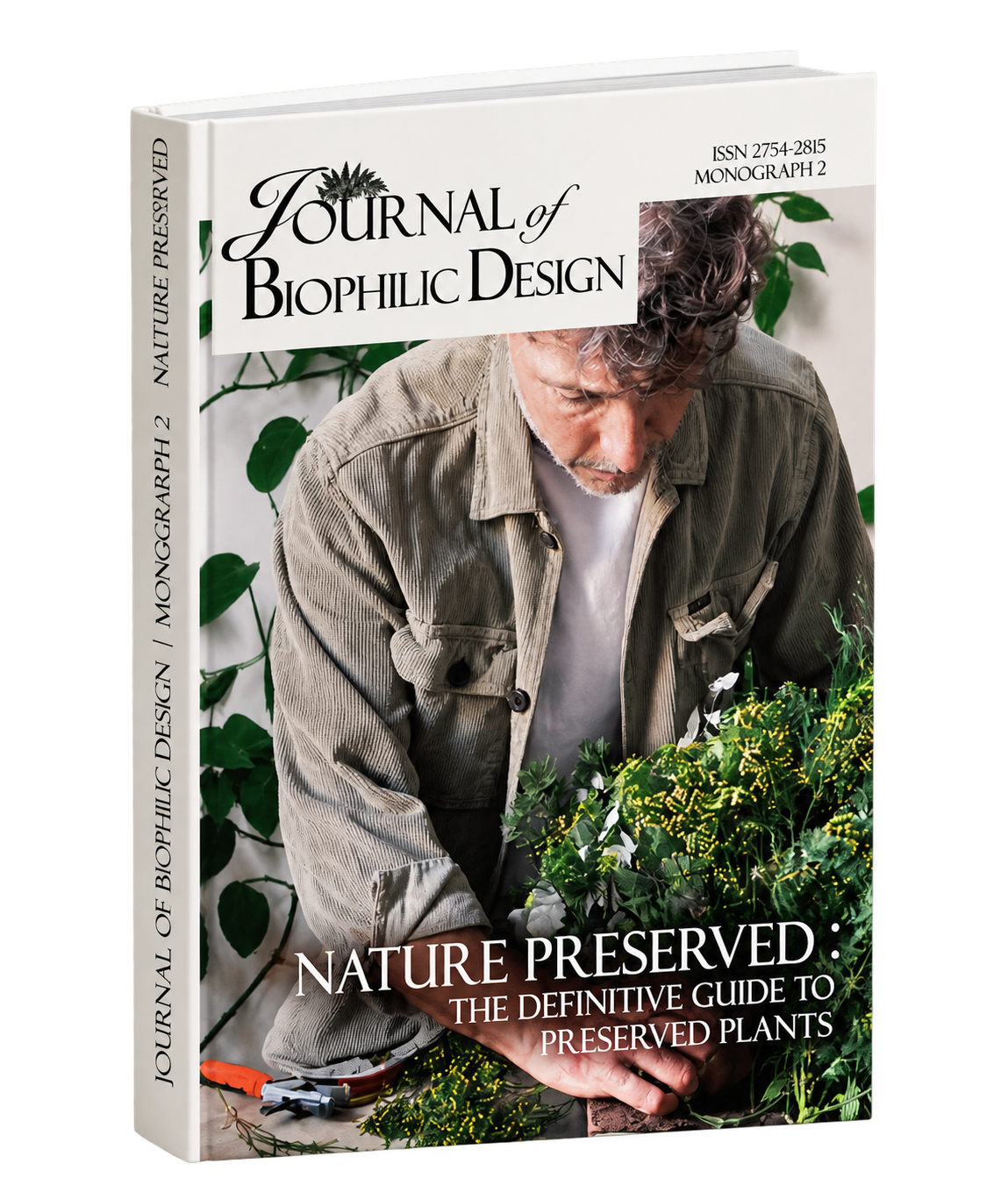
Download Nature Preserved for free
Nature Preserved — The Definitive Guide to Preserved Plants
by Edgardo Rossi
Foreword by Dr Vanessa Champion
In collaboration with the Journal of Biophilic Design
16 chapters and 3 case studies
Approximately 130 pages
In English
✨ Free to download and read online